
Finance minister Nirmala Sitharaman on Wednesday exuded confidence that inflation would further decline and the government is on track to meet its budgetary target for deficit and said that there is no fear of stagflation in India. Replying to the debate on first batch of Supplementary Demands for Grants 2022-23 in Lok Sabha, the finance minister said inflation has come down and it is now in the tolerable band of the RBI. Inflation has been declining since April 2022 and it is declining further, she said.
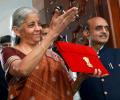
At the customary post-Budget media interactions, Finance Minister Nirmala Sitharaman and her topmost bureaucrats touched upon a number of issues. The minister said the government taxing income from digital virtual assets did not give them legitimacy and that issue was being dealt separately in the planned cryptocurrency Bill. She also expressed confidence that the Budget targets were achievable.
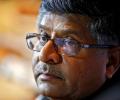
The Cabinet on Wednesday approved public private partnership mode for the rollout of BharatNet project for broadband services in villages in 16 states with viability gap funding of Rs 19,041 crore, Telecom Minister Ravi Shankar Prasad said. Prasad said the decision to involve private players was taken after Prime Minister Narendra Modi announced on August 15, 2020 that around 6 lakh villages in the country will be connected with broadband in 1,000 days. "The Cabinet has in-principle approved implementation of BharatNet in 16 states in a public private partnership model with total expense of Rs 29,430 crore.
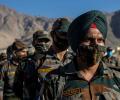
The political-electoral calculus favours spending thousands of crores on vanity projects like Sardar Patel's statue and the Central Vista over building up our military to handle the confrontations and conflicts that loom large, points out Ajai Shukla.

There will be pressure on the fiscal situation, especially at a time when the monsoon can also disappoint. More populist expenditure is on cards if the mandate is a hung Parliament or a coalition government.

Most have seen decline in cash reserves and deterioration in financial ratios in recent years.

While no specific state-oriented sops were rolled out, a strong thread of political wellness ran through the Budget.
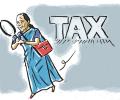
The continuing fiscal stimulus is heavily tilted towards capex, to the extent that it chips away a part of revenue spending. Accounting for other areas of revenue expenditure, such as salaries, pensions, subsidies and defence (committed spend), the room to spend on welfare schemes, health and education will narrow in FY22.

According to software company Mavernir, the new virtualised networks would lead to a saving of 40 per cent in capex and 34 per cent in terms of lower operations cost for operators.

The Reserve Bank's growth projection for next financial year is lower than 8-8.5 per cent projected by the finance ministry in the recent Economic Survey which was tabled in Parliament on January 31. Unveiling the bi-monthly policy, RBI governor Shaktikanta Das said, "Recovery in domestic economic activity is yet to be broad-based, as private consumption and contact-intensive services remain below pre-pandemic levels."

'Recent underperformance notwithstanding, equities should constitute a major part of investors' financial portfolio.'

However, economic growth in five years of the UPA and NDA cannot be compared because of the now complex back series data, reports Indivjal Dhasmana.

Richest Indian Gautam Adani's ports-to-power-to-cement conglomerate is "deeply overleveraged" with the group predominantly using debt to invest aggressively across existing as well as new businesses, CreditSights, a Fitch Group unit, said on Tuesday. In a report titled 'Adani Group: Deeply Overleveraged', CreditSights said, "In the worst-case scenario, overly ambitious debt-funded growth plans could eventually spiral into a massive debt trap, and possibly culminate into a distressed situation or default of one or more group companies." Starting out as a commodities trader in the late 1980s, the Adani group has diversified from mines, ports and power plants into airports, data centers and defence.
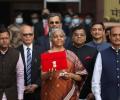
'India's output contraction in the previous year was among the worst in the world!'

'Our advice is to put money into equities now rather than staying away.'

Modi govt must implement few policy measures which it announced in Budget 2015.

In the upcoming round of privatisation, unviable airports are likely to be clubbed with six main airports and a prospective bidder may be restricted to bid for two airports.

Govt squeezed capital expenditure, and also cut revenue expenditure, that does not go into creating assets, by 11% in H1

Relax fiscal consolidation, boost public capex and reduce cost of finance, industry tells Centre

A communiqu sent by the department of investment and public asset management (DIPAM) to the heads of all PSUs, said the move would help the government to get predictable and periodic dividends before Budget estimates are firmed up.
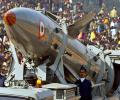
Free provision of food, cash transfers, and jobs in villages see enhanced flow of funds despite a precipitous fall in revenue. Till May, defence spend was nearly 30 per cent less than the previous year.
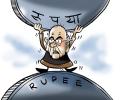
For the first eight months of the current financial year, the figure stood at Rs 7.17 trillion.

'India has entered an economic super-cycle driven by a housing cycle turnaround.'
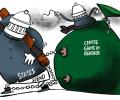
This may lead to the states' combined fiscal deficit to widen much faster, while the Centre may show a smaller or insignificant slippage in meeting its deficit target. The Centre will celebrate over its fiscal prudence, but the states would suffer, A K Bhattacharya points out.
'A total overall of the existing way of working by abolishing taxes and allowing citizens to help themselves without any government bottlenecks and impediments,' observes Rahul Mishra.

Finance Minister Nirmala Sitharaman on Tuesday unveiled a Rs 39.45 lakh crore Budget with a view to fire up the key engines of the economy to sustain a world-beating recovery from the pandemic. This was Sitharaman's fourth Budget. While the taxpayers were left in the lurch, once again, was she able to cheer Corporate India?

Adar Poonawalla says it took a five-minute chat with his father Cyrus before making the decision to manufacture Covishield. The bet paid off, and handsomely. Serum Institute now has the capacity to make 4 billion doses of Covishield annually.
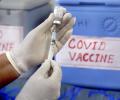
Maintaining a rapid pace of the vaccination drive and quickly bridging healthcare infrastructure gaps across both urban and rural areas would emerge as the most sustainable stimulus for durable recovery of the Indian economy, says a report by the department of economic affairs.
Capex for next year expected to be up 25% to Rs 3 lakh crore

'It is a worrying trend as we are not seeing too much fresh capital being raised for new projects, plants, expansion or diversification. It's just private equity or venture capital or promoters cashing out.'
Has the army confronted China, equipping itself with emergency purchases that have been largely paid for by pensioners, asks Ajai Shukla.
'Modi looks to be an effective, result-oriented, purposeful leader, focused on bringing greatness and glory to the nation.'
'
So it is best for his critics to give up their sniping and supplement his efforts,' asserts B S Raghavan, the distinguished civil servant who served three prime ministers.

Over 93% of the orders in the year came from the central and state governments, PSUs, and NHAI.

The Budget kept away from mood dampeners such as an increase in taxes (capital gain taxes) and even the much-feared introduction of Covid cess and wealth taxes, says Nimesh Kampani, chairman, JM Financial.

The broadening of the market rally sends the signal that growth will be broad-based, observes Akash Prakash.

Sitharaman also said that the government's capital expenditure was on track and Budget estimates would be met.

While the likelihood of these states going the Lanka or Greece way may be an alarming assessment, the financial situation of some states such as Punjab and West Bengal is indeed quite weak.

The divestment process, however, will not be an easy affair as there are multiple stakeholders, including the employee unions, whose concerns will have to be addressed.

While Governor Das was sanguine on government walking the fiscal prudence path--which was missed three out of the five budgets of the Modi government--Acharya pointed to the fiscal slippages as a worry.

Govt is likely to find it hard to meet deficit target next year.
 © 2026 Rediff.com - Advertise with us - Disclaimer - Privacy Policy - Sitemap - Feedback - About us - Terms of use - Grievances